
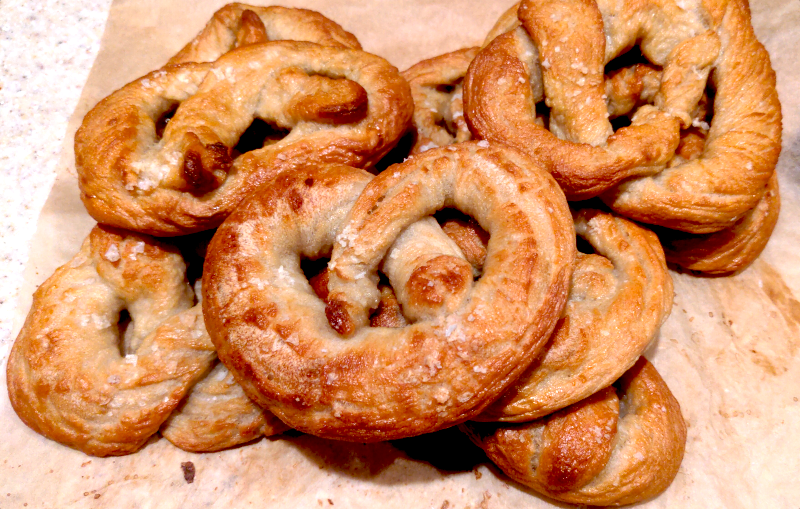
Having my sourdough starter being super active while baking lots of loaves of bread (doubling in about 3 hours), I ventured out into snack land, and decided to make sourdough pretzels. It turned out great! While still working on refining their final look, the flavor and texture (chewy like a good soft pretzel) are spot on!
I typically like to mix all-purpose with another type of flour, to make my sourdough goods a little more interesting in flavor, color, and texture. This recipe could simply be made with 100% AP, which will make the dough less sticky, than if you add, say, whole wheat flour, which will make the dough stickier. Finding the right balance of pressure on the dough as you roll, as well as the right amount of flour to add to your rolling surface are keys to getting evenly shaped rods. Too much, and the dough slides rather than rolls. Not enough, and it sticks. It takes a bit of practice to finesse the dough, but is worth the effort!
You can customize the herb mixture, or just keep it classic and use salt. A finishing salt with large grains, or kosher salt work best for sprinkling on top. And of course, there’s always “pretzel salt” you could use, although unless it has at least three different uses, I don’t keep an ingredient in my kitchen.
Serve with fermented mustard or your favorite dip!


Sourdough Soft Pretzels
Equipment
- large heavy mixing bowl
- heavy dutch oven with lid or bread baker
- bench or dough scraper
- digital kitchen scale
- serrated bread knife
- Silicone spatula or Danish dough whisk
- tea ball/steeper
Ingredients
- 375 grams warmed (80°F/27°C) water
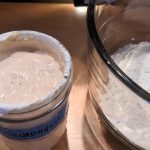
- 100 grams active sourdough starter
- 500 grams flour total:
- - 400 grams all-purpose flour
- - 100 grams: whole wheat, spelt, or bread flour
- 1 Tbsp (15 ml) baking soda
- 1 egg or almond milk if vegan
- 10 grams salt
- kosher or other finishing salt to taste
- dried herbs to taste caraway, oregano, fennel, poppy seeds, e.g.
Instructions
Activate Starter (6 to 8 hours)
- Discard all but 3 tablespoons (50g) of starter. You can use discarded starter for other purposes.
- Mix in 50 grams of 78°F/26°C water and 50 grams all-purpose flour.
- Mix thoroughly until there aren’t any dry bits of flour.
- Cover mixture with a towel or paper towel and let it rise overnight or about 6 to 8 hours. Ideally, you are ready to start mixing dough when the starter has doubled (or more) in volume.
Mix Dough (1 hour)
- In a large heavy bowl, mix 375 ml (12.7 oz) warmed water, salt and 100 grams (2/3 cup) of active starter. (Leave enough starter to keep it going.)
- Add the flour(s) and mix thoroughly with spatula or dough whisk, making a "shaggy" dough. Ensure there aren’t any dry bits of flour.
- Cover bowl with dish towel and let the dough rest for 1 hour.
- At the end of the resting period, dough should look less shaggy and smoother.
- Make two turns on the dough, then cover bowl with a dish towel or tea towel.
- To do one turn, take the side of the dough furthest away ("12:00" of the bowl), and gently lift it out of the bowl until it stretches, then fold it back on itself towards you ("6:00" of the bowl). Wait 10 seconds. Turn the bowl one-third (about 120 degrees) and repeat the lift and fold. Wait 10 seconds, turn bowl one-third and repeat lifting and folding. This is one turn.
Bulk Fermentation (4 hours)
- This is the first rise for your bread, and it will take 3 to 4 hours if your kitchen is relatively warm (78-82°F / 25-28°C). In a cooler kitchen, it will take at least 4 hours, maybe longer.
- Every 30 minutes, do one gentle turn of the dough (see above).
- The dough will increase in volume noticeably and appear smoother after a few hours.
Shape & Parboil Pretzels (30 minutes)
- In a pot, bring a gallon (4 liters) of water with 1 Tbsp. of baking soda mixed in to a boil.
- Flour your work surface well. A tea ball/steeper works well for dusting flour evenly.
- Pour the dough out onto floured surface. With a sharp-edged bench/dough scraper, divide the dough into 12 equal pieces. Each piece should weigh about 85 grams.
- Roll each piece into an even rod, about 24 inches (100cm) long and 1/2" (1 cm) in diameter, about the thickness of your pinky finger.
- Prepare two cookie sheet pans covered with parchment paper or a silicone mat.
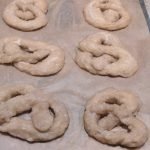
- Shape each dough rod into a pretzel by placing the curved end down first, then looping around and crossing each end to make a pretzel shape. Carefully move to the sheet pan.
- Preheat oven to 450°F/232°C.
- Four at a time, carefully place each dough into the boiling water. Remove pretzel when it floats, after about 1 minute. Drain well on a cooling rack, and place them onto the cookie sheets.
Bake Pretzels (50 minutes)
- Beat egg (or add 1/3 cup or 80 ml almond milk) and 1/4 cup (60 ml) water together in a small bowl. Brush mixture on evenly on each pretzel.
- Sprinkle finishing salt and/or dried herbs evenly onto each pretzel.
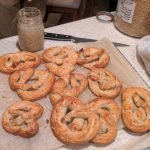
- Bake for 45 to 50 minutes, or until the pretzels are evenly brown. Rotate and switch the pans halfway through to ensure even baking.
- Remove and place on cooling rack for at least 30 minutes. Serve with honey mustard or your favorite dipping sauce.
- If any remain, store in airtight bag at room temperature for up to 3 days, or freeze for up to 1 month.

Author and founder of Fermenters Club. I’ve been fermenting food for 14 years.
In 2024, I published my first book, Fearless Fermenting.
When not stuffing things into jars, I enjoy permaculture gardening, cooking, yoga, writing, and studying cosmology and esoteric traditions.
Thanks! I am very new to baking in general so I don’t know how qualified I am to give tips. =D The convection setting is my best guess of what went wrong. I used 100g King Arthur unbleached bread flower (12.7% protein) + 400g AP flower.
Trying to think if I did anything else differently from the recipe… I wasn’t kneading every 30 min the entire 4 hours it was fermenting. I probably did three or four turns when first mixing in the salt water; after that, I think I did two turns at 30 minute intervals. I thought it might have made them a little more dense but I didn’t think it would affect the baking time that dramatically. I also lined the mixing bowl with rice flour to help combat the stickiness. Some of it probably got mixed in.
I will try it again without the convection setting next week or so if I have time and see if it has a big impact.
First time trying to make pretzels, I used this recipe. 45 min @ 450 convection was WAY too much. I took them out at 43 min and they were burnt and rock hard. I haven’t tried using convection before, but I think you should consider posting separate baking instructions for convection.
If I were to bake this again I would add the salt at the beginning and skip the extra 25g of water (it made the dough really sticky and hard to work with) and probably try lowering the temperature after the first 10 minutes.
Thanks for the tips, Russ! I removed the convection oven step and tightened up the dough prep steps a bit. What type and ratio of flours did you use? That contributes to the stickiness of the dough.
Cheers!