

Slow cured non-alcoholic eggnog made with kefir is a new spin on the iconic holiday beverage, and elevates it to new heights (literally!) It has a creamy, fizzy sweetness and a wonderful mouth feel. It is rich and frothy, like a whipped or soft-serve ice cream, with no whipping needed!
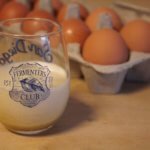
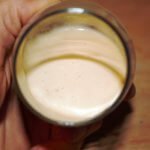
WARNING: Even in the refrigerator, pressure builds up with this ferment! We recommend consuming within 4 weeks. There have been some unexpected messes made in my kitchen with eggnog that’s older than this!
Kefir Eggnog
Ingredients
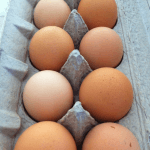
- 6 large pasture-raised chicken eggs
- 5/8 cup (110 g) raw cane sugar
- 3 Tbsp (60 g) raw honey
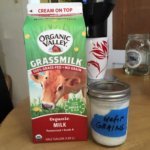
- 12 oz (355 ml) Milk Kefir
- 12 oz (355 ml) organic, grass-fed heavy cream
- 1/2 tsp (2 g) freshly grated nutmeg
- 1/8 teaspoon (2 g) fine sea salt
Instructions
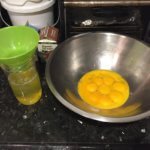
- Separate the egg yolks from the whites, and store/use the whites for another purpose.
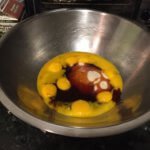
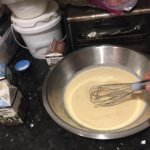
- Combine yolks with the honey, sugar, salt and nutmeg in a large mixing bowl and beat or use hand mixer until the mixture is smooth (no lumps) and turns a light yellow color.
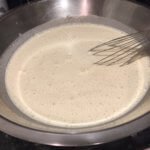
- Stir the kefir and heavy cream slowly into the egg mixture.
- Dispense mixture into glass bottle (about one liter-sized bottle e.g.) that have tight-fitting bottle caps or swing top style lids. Tighten the lid.
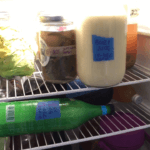
- Place bottle in the refrigerator to cure for 7 days. The nog will slowly but significantly thicken and build up pleasant carbonation as it cures.
- Separation of ingredients during curing is normal, especially if you use unhomogenized or raw dairy (the cream really does rise to the top). Gently invert and rotate bottle as needed to reincorporate the nog ingredients until is consistent throughout the bottle. Do not shake the bottle!
- Be careful when opening-- pressure can release slowly or quickly. It's best to open slowly over the kitchen sink, with the bottle over a bowl to catch any extra that spills over if the pressure is great.
- For the best texture, let eggnog warm and expand slightly before enjoying. You should notice it getting nice and bubbly! It will be better and more unctuous than the richest cappuccino you've ever had. (This final step is worth waiting for!)
- Store in refrigerator. Consume within 4 weeks.
The Boozy Version
You can also make a boozy version of kefir eggnog. The kefir yeasts and bacteria do not survive the high alcohol (up to 20% abv) environment, so the texture of the finished nog will be different from the non-boozy kind. It still contains many of the added nutritional benefits of kefir versus milk, just without the probiotic element. It won’t be as frothy on its own (you can always whip it or add whipped cream into it).
I made two batches side by side, one with alcohol and the other without. Only the non-alcoholic version showed signs of development in the fridge (which acts as a fermentation “super-slow-mo” button). In fact, it thickened quite nicely, too. The alcoholic version was tasty but other than a slightly more sour flavor, it didn’t differ much from traditional nog recipes (i.e. which use non-cultured dairy).
BOOZY RECIPE
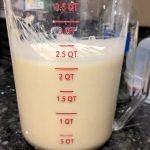
Add 3 cups of distilled spirits (I use a combo of 1 cup rum, 1 cup cognac, and 1 cup whiskey) to the base mixture and then bottle. Will yield 2.75 liters, or about 3 quarts. If you’re making the boozy kind, don’t worry about carbonation building up– the high alcohol content kills the yeasts & bacteria.
It’s still best to let the boozy version cure in the fridge. It gets better with age, with 4 to 6 months being the peak flavor.
On Using Raw Eggs
This recipe uses raw eggs. Be careful when consuming eggs– there is an extremely small risk (1 in 30,000)[1] of food poisoning from raw eggs. Always be sure to buy your eggs from a reputable farmer/source. If you are squeamish about using raw, you can use pasteurized eggs for this recipe.
There is evidence to support the fact that kefir bacteria and the organic acids they produce during fermentation ward off pathogenic bacteria such as E. coli, Listeria, and Salmonella. so even though we are using raw eggs, the kefir offers a protective effect against bad bacteria.
Sources
- Is Eating Raw Eggs Safe and Healthy? Healthline. Accessed Dec. 20, 2018.
- Bacterial Inhibition and Antioxidant Activity of Kefir Produced from Thai Jasmine Rice Milk. Accessed Dec. 20, 2018.
- 9 Evidence-Based Health Benefits of Kefir. Healthline. Accessed Dec. 20, 2018.
- Alton Brown’s Aged eggnog recipe. altonbrown.com. Accessed Dec. 20, 2018.

Author and founder of Fermenters Club. I’ve been fermenting food for 14 years.
In 2024, I published my first book, Fearless Fermenting.
When not stuffing things into jars, I enjoy permaculture gardening, cooking, yoga, writing, and studying cosmology and esoteric traditions.
Austin — I have a question about booze vs. non-booze options. Have you tried making the non-booze version, letting it ferment, then adding the booze after a week in the fridge?
Also, for the non-booze recipe it says “Store in refrigerator. Consume within 4 weeks.” But for the booze version, it says “It gets better with age, with 4 to 6 months being the peak flavor.” Is this difference in time scale for freshness due to the booze killing the various bacteria?
Thanks!
Hi Rob,
Yes, that’s exactly right. The high alcohol and the long soak do kill the probiotics in the boozy version. The non-alcoholic, on the other hand, seems to feed on all the nutrients in all the other ingredients, which is why it gets MORE feisty and should be consumed in about a month. It also starts to get funky after that timeframe.
So… I put together a homesteaders version of George Wahington’s eggnog (ie Aged eggnog). This one used whole eggs in it, eggs , sugar, milk, and a splash of cream and is shelf stable due to all the alcohol sterilizing it… so it is sort of an eggnog concintrate to which after 3 or more months you blend with milk and cream and of course nutmeg. Too much milk for me as you add to each each cup of concintrate ,1.5 cup of milk and a splash of cream and of course the nutmeg. I can handle Kiefer, cream and butter, but milk gives my gut fits if I get too much. trying to figure out if this kefir will work for the recipe. I think it might, and want to try it like that. ( or I might go to my goat milk dairy and try raw goat milk in it when I use the concintrate to make my beverage.) I got into this trying to find more ways to store eggs long term, LOL! Think it’ll work out ok to use kiefer in the part you add to the concintrate?
That sounds interesting. I haven’t tried the concentrate technique. At such a high level of alcohol (in our recipe, 20%), the kefir culture will probably not survive. However it should be fine to use in the concentrate. The other option is to use kefir and cream when you are preparing it (not in the concentrate).