

Have you ever made a batch of pickles that weren’t crisp and they’re just not enjoyable in their fresh form?
Or, maybe you’ve have a jar that has sat in the fridge too long, and they’ve become to soggy to enjoy. Fear not, Fermenter! Dehydrate them into powder, preserving all that flavor!
Having spotted garlic dill flavored crunchy-salty snacks at the market, I wondered if I could make a similar pickle powder simply by dehydrating those extra or lackluster pickles? (Wait, you’re thinking. What do you mean by “extra” pickles? The concept was new to me, too.)


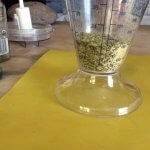
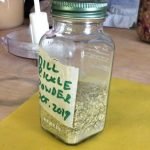

As an aside, I was curious to know, if by keeping the dehydrating temperature below 110°F / 43°C (the rough definition of “raw” food), whether the probiotic bacteria survived. So one week after drying, I rehydrated some of the powder, and placed it in an airtight container at room temperature to see if I could detect any bubbling (a sure sign of living bacteria!) THEY DID NOT SEEM TO SURVIVE. After a few days, the test container smelled rancid and was not bubbling.
Dill Pickle Powder (Seasoning)
Equipment
- dehydrator
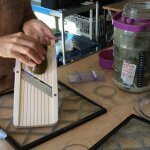
- mandoline or v-slicer
Ingredients
- 1 lb. (500g) dill pickles
Instructions
- Slice pickles lengthwise into thin 1/4" (1/2 cm) slices.
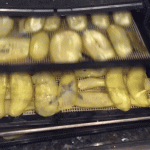
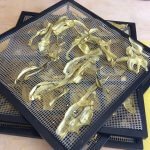
- Place in a single layer onto dehydrator trays. Set temperature to 105°F (40°C) or lower.
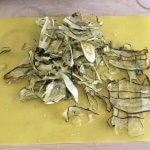
- Dry thoroughly for 12 to 24 hours, until pieces snap and crumble in your hand.
- Pulverize pieces into a powder using a blender, food processor, or a mortar and pestle.
- Store powder in an airtight container in a cool place, away from direct light, heat, and moisture. Lasts years if kept in these conditions.

Author and founder of Fermenters Club. I’ve been fermenting food for 14 years.
In 2024, I published my first book, Fearless Fermenting.
When not stuffing things into jars, I enjoy permaculture gardening, cooking, yoga, writing, and studying cosmology and esoteric traditions.
It’s interesting that the bacteria didn’t survive. I wonder how probiotics can be sold in capsules? I think I read somewhere that it’s just foods that microbiotics enjoy?
Another rabbit hole! :))
Probiotic capsules are filled with, say 100 million CFU (colony forming units) and then dehydrated, likely at much lower temperatures. Then they study how many survive from when they’re added to the capsule until someone ingests them. An average pill may claim 10 million CFU (10% of the original amount.)
In my case, it was probably a combination of heat and overly drying them out that did them in (nothing can survive without water, although bacteria can survive a long time in suspended animation!)