

The kimchi “paste” is the heart and soul of kimchi, as you slather some lucky vegetables with the iconic flavors of garlic, onions, ginger, and chile pepper. I find that preparing the paste is the most time-consuming part of the kimchi-making process (especially peeling that garlic!)
“Spending some time up front to make kimchi paste is worth the effort.”
Make-ahead kimchi paste lasts a very long time (at least 3 months) when tightly sealed in the refrigerator. Note that we are not fermenting the paste yet; simply preparing it for when we are ready to make our next batch of kimchi.
I use wide-mouth glass jars to store my paste. It makes it easy to scoop out with a spatula or a gloved hand.
Sourcing Gochugaru (red pepper powder)
In Korean, Gochu means pepper, garu means ground. Ground chile pepper is what gives kimchi its iconic flavor and color. Look for medium or coarsely ground powder. (Save the fine ground as a garnish/for more refined dishes).
At an Asian Market
If you’re lucky enough to live in a city with an Asian market, you can often find a section of the market with many different brands.
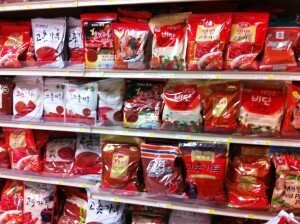
Online Options
If you don’t have an Asian market nearby, Amazon carries all sorts of brands. I prefer brands that are either made in Korea (for example this one or this one), which are notably more expensive than those which are made in China. Since I live in the united States, I also sometimes choose brands made in Mexico.

Zen and the Art of Peeling Garlic
Ever since attending a ten-day Vipassana meditation a few years ago, I have shifted how I experience what I used to consider tedious tasks. I used to view them as something to avoid, complain about, or to rush through. In kimchi-making, this shows up as the garlic peeling. I now view this part of the process as a working meditation, since there appear to be no shortcuts I have found to truly speed up the process of removing the paper from the cloves.
Sure, you could shortcut the whole thing by buying pre-peeled garlic, but as an allium, garlic cloves contain many volatile compounds which evaporate quickly upon handling. There is organic domestic (to the united States) garlic that is sealed into small packets, but it uses a lot of plastic, and is highly perishable and expensive. You can find bulk amounts (3 or 5 lbs.) of less expensive peeled garlic, but there’s a 99% probability that it comes from China. I embrace the realities of the global economy (most of our “stuff” these days is made somewhere in Asia), but when it comes to sourcing food ingredients, I prefer to buy domestically and as locally as possible.
Take it for a spin
I use a standard sized (6 to 8 cup capacity) food processor to make the paste. In fact, I have one that is dedicated just for kimchi-making, separate from my everyday kitchen processor.



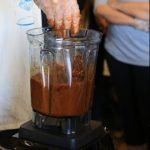
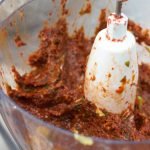
Need recipe inspiration? We’ve got a whole chapter on kimchi in my new book!
How about traditional kimchi, radish kimchi, and more? Most recipes on our website call for about a half-pint (8 ounces by volume) of paste.
This is a vegan variety; if you want to make it more traditional (“fishy”), add a few canned anchovies to the paste before blending. Or, add a few splashes of preservative-free fish sauce, or make your own fermented fish sauce! You can also splash fish sauce at the time of making kimchi (directly into the vegetable mixture) too.

Author and founder of Fermenters Club. I’ve been fermenting food for 14 years.
In 2024, I published my first book, Fearless Fermenting.
When not stuffing things into jars, I enjoy permaculture gardening, cooking, yoga, writing, and studying cosmology and esoteric traditions.
Regarding the task of removing the peel on garlic, just lightly or medium hit (or heavily if you want really smash the garlic) the garlic under your knife, the paper slips off much easier. I use to cut off the tips but you really don’t need to as the food processor chops the ends fine enough.
Yup, that’s a great way to easily peel garlic!
I read that in the cabbage soak the salinity (amount of salt used) should be about 1-2% of the weight of the cabbage. How much spice page should be used as a percentage of the weight of the cabbage plus fillings (scallions, carrots, radish and so on).
Also, do you use a slurry that is mixed with the spice paste when you are ready to mix the KimChi?
Look at the classic kimchi recipe to get a sense of the ratios of paste to the other ingredients: https://fermentersclub.com/kimchi
Waaaay to much garlic! Completely inedible. Made everything in fridge taste and smell of garlic. Possibly they used super weak garlic.
Ooops, shoot! You’re right! They were too high before. We adjusted the garlic and ginger amounts in the recipe to reflect a more balanced paste.
You could save the paste by simply adding another 2 bunches or so of green onions, more powder, and tamari, to adjust the flavor and cut it down.
Thanks for the feedback!
Pingback: Strawberry Chutney | Fermenters Club
Pingback: Kimchi (Napa Cabbage) 김치 | Fermenters Club
Pingback: Pickled Watermelon Rinds | Fermenters Club